

Why full-stack growth leaders will own the next decade
The era of specialized growth teams is over. AI has changed the growth game. Here’s why the future will be driven by full-stack growth.


Fast growth has never been easier. Retention has never been harder.
This tension dictates why the next decade belongs to full-stack growth leaders.
The growth function has evolved over the past two decades. I’ve seen it firsthand, as the first growth hire for companies such as Pinterest, Facebook, Instagram, and Descript. We can clearly identify three eras of growth:
2000s - the data-driven era - We started putting numbers and systems behind growth efforts. This was when Dropbox’s referral program emerged, and Facebook identified its “7 friends in 10 days” activation metric. Everyone rushed to find their own version of it.
2010s - retention and monetization - Mobile notifications became the prime lever for engagement. Social products finally put a business model on top of usage, and growth moved to embedded teams working together with product and engineering.
2020s - PLG, or product-led growth, goes mainstream - The pandemic made digital growth a key priority, and hiring for the function took off.
In 2025, we’re at an inflection point entering yet another era, where growth is becoming increasingly full-stack, accelerated by the rise of AI.
What is full-stack growth?
Full-stack growth combines inputs across product, marketing, engineering, data, and operations to generate growth outputs. As AI collapses functional silos, full-stack growth teams become the connective tissue between a product and the work needed to make distribution, retention, and monetization happen.
I’ve been operating this way my entire career, mostly by accident.
For years, I didn’t fit squarely into a “growth marketing” or “growth product” role, because most companies still expect those to be distinct. At Pinterest, I wrote my own SQL queries to size opportunities, developed experiment segments, sent data-triggered notification campaigns, set up and ran user acquisition ads, and designed in-product and email onboarding flows.
Back then, being a growth generalist felt like a curse, too broad to fit within a siloed org chart. But now that AI makes cross-functional workflows faster and smarter, those hybrid skills are the exact edge companies need.
Take user acquisition for example. Traditionally, a product team’s scope might end at share loops, invites, or collaboration features. A full-stack operator, however, knows how to reach the user in the upper funnel through channels like SEO or paid ads and can convert into active users through product flows that compound over time.
That’s the core of full-stack growth: the ability to bridge silos, orchestrate across cross-functional systems, and move from insight to execution with tremendous speed.
That’s why this next decade of the fastest-growing companies will be driven by full-stack growth leaders.
Why the future of growth is full-stack
1. Founders wear the growth hat earlier
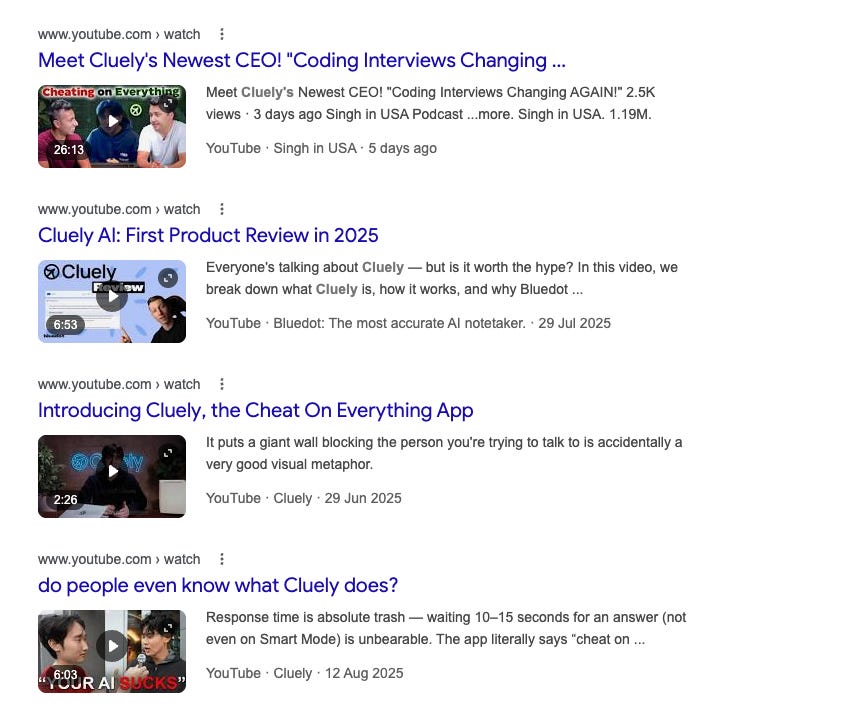
More and more, we’re seeing companies engineered for distribution before they’re engineered for retention. For example, Cluely’s founder built a growth engine by turning himself into a content creator and reaching tens of millions of organic views and a $15M raise off the back of social video.
Whether retention and unit economics follow is a separate question, but the first swing at distribution now happens immediately.
2. AI is collapsing the growth stack
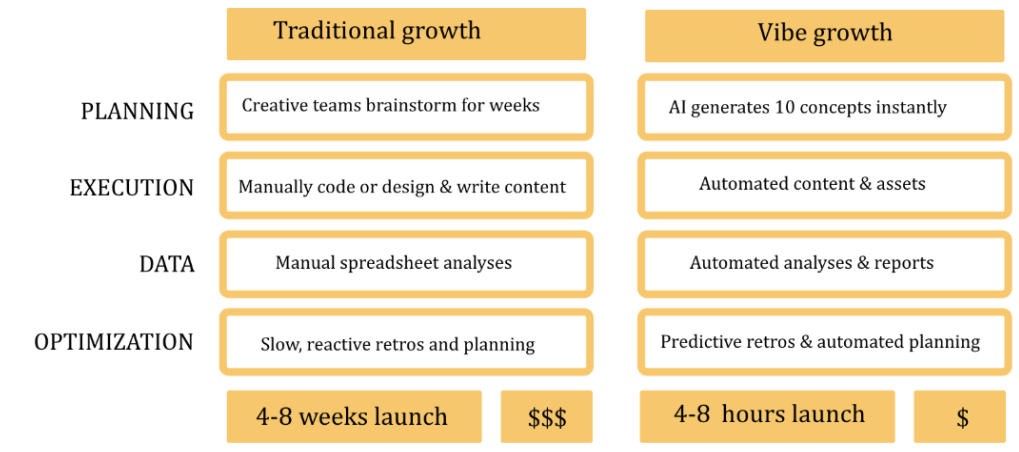
What used to take a team of analytics, business operations, creatives, and engineers now fits into the hands of just one person.
When I worked on growth with Limitless, I built a product roadmap, generated lifecycle content with AI, set up Zapier automations to connect data and notifications, set up Amplitude charts, and used AI to analyze campaign results - all as a solo operator.
Previously, this would’ve required multiple people, a big budget, and weeks or months to launch. Now you can achieve the same outcome in hours or days.
3. Agentic automation has changed the game
Agents are the next evolution of tools.
Unlike traditional AI software that requires human input and oversight, agents can autonomously make decisions, execute workflows, and go from information to action. This happens for both internal and external agents.
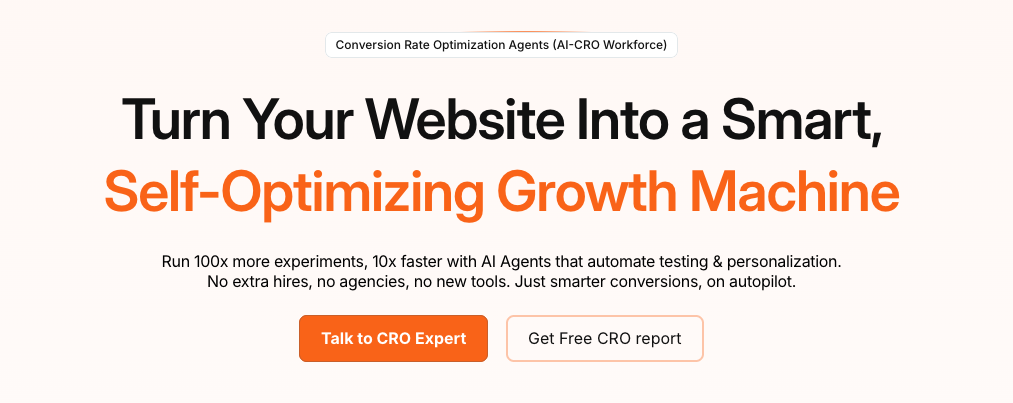
Internal agents now handle work we used to hand off across several teams. As an example, Fibr AI can connect to Google Analytics, read a landing page, generate hypotheses, implement creative changes, deploy variants, and track data to make decisions about the winning variants.
External agents can run customer interviews, conduct voice-led onboarding, and recruit candidates. The possibilities are endless. As an example, here’s a prompt I created to use a Manus AI agent to summarize news articles for an email newsletter (which can replace the work of a junior marketer who is spending hours reading and summarizing articles each week).
4. Companies are pursuing monetization much earlier
Monetization is the most full-stack game in growth.
It involves product decisions, code changes, CEO buy-in, and sales in the loop. It touches every other function.
But just ten years ago, even breakout consumer products took years to monetize. Pinterest was founded in 2009 and didn’t start running ads until 2014. Instagram, Snapchat, and Twitter all followed a similar pattern.
Contrast that with today’s AI-native products: Perplexity launched in late 2022 and rolled out Pro subscriptions by mid-2023. Midjourney went from a Discord beta to roughly $200M ARR in under two years.
This early monetization creates capital that can be reinvested into growth much sooner. This enables companies to invest in paid and other scalable marketing channels much earlier.
5. Enterprise-grade channels are now available to startups
Growth channels once reserved for mature organizations are now available to small teams.
Take programmatic SEO: it used to require heavy human resources, but now startups like OpenArt use it as a growth engine: their Studio Ghibli generator gained huge visibility across both traditional and generative search.
Another example: AnswersAI built its distribution strategy on influencer marketing by working with content creators and iterating quickly on owned branded content, a strategy that is usually reserved for brands with larger budgets and more creative cycles.
Across these examples, the theme is the same: growth at scale is now accessible at the earliest stages.
What full-stack growth talent looks like
I often get asked who would be the best hire to bring into a company in the early stages to accelerate growth. My answer: a full-stack growth lead who can build growth, product, engineering, and marketing into a single function.
Growth marketers will need to become growth engineers, and vice versa. Some bullets that you might use for a job description for a modern founding growth hire:
Code and deploy programmatic landing pages
Build automation and AI agent workflows for research and execution
Generate synthetic profiles to create customer segments and identify product strategy and GTM avenues
Set up analytics, and use data to identify opportunities
Run creative and copy experiments at scale
But don’t confuse the breadth of skills here with those of a traditional generalist.
Being a generalist often implies having surface-level knowledge across many areas. What’s emerging is something deeper: operators who are technically and operationally fluent, capable of designing deep and comprehensive growth systems.
My prediction is that even director or senior leaders will need to have or be able to manage all these capabilities. They need to understand the mechanics well enough to direct execution, spot bottlenecks, and make strategic calls across the entire stack.
Does this reduce teams to “teams of one”? Occasionally, yes. You can prove a motion with one strong operator, especially for those hiring their first growth person or in an early-stage team pre-Series B. But scaling growth still demands more full-stack hires, each capable of owning an initiative with minimal handoff cost.
The paradox: growth velocity without depth
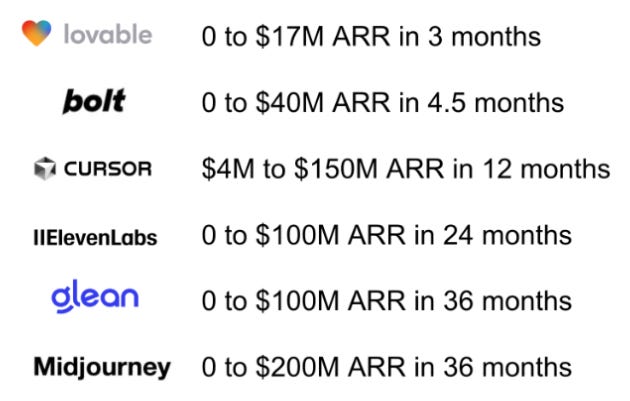
Teams can now ship and test faster than ever, cutting development and creative cycles down to days. But speed comes with a tradeoff.
Instead of spending long cycles understanding long-term impact, teams are taking shortcuts. Not intentionally reckless ones, just purposeful bets that favor speed over certainty.
It’s easy to start fast. It’s much harder to repeat and scale.In the short term, companies can capture attention by making big promises. We’re already seeing signs that retention is declining, so while AI-native startups are hitting their first million ARR 3x as fast as predecessors, we have yet to see how retentive that revenue is, or if we’re churning through the market faster.
How to prepare for the future
If speed is the new reality, execution has become the only defensible moat in the era of AI.
The goal is to move fast enough that you can test, iterate, and improve before your competition even ships their first version.
First-mover advantage is back. For a while, it didn’t seem to matter much, but now those who emerge first get recognition as the go-to product in their category - something that competitors struggle to displace. And when you go first, you get a head start on building the execution moat: the right combination of team, AI-native workflows, and strategic distribution that compounds over time.
I see a future where operators can swiftly move across the growth full-stack, using AI to multiply their impact, and execute with enough speed and precision to own their category before anyone else figures out how.
If I’m right, only time will tell. But in the meantime, I’m building for it and helping startups do the same. If you want help building your execution moat, reach out.